

We’re excited to announce that Highcharts has joined a group of innovators led by Jenna Gorlewicz, Ph.D., Associate Professor in Aerospace and Mechanical Engineering and Associate Dean of Research and Innovation in the School of Science and Engineering at Saint Louis University, as well as partners at UNAR Labs, ViewPlus Technologies, and Vital to develop a new technology called Inclusio, an innovative content platform that enables anyone to find and create accessible content, particularly people with blindness or low vision.
The collaborative team made up of accessibility and technology experts from academia, industry, startups and nonprofits was recently awarded a five million dollar grant by the U.S. National Science Foundation to advance to Phase II of the NSF’s Convergence Accelerator Program, 2022 Cohort, Track H: Enhancing Opportunities for Persons with Disabilities.
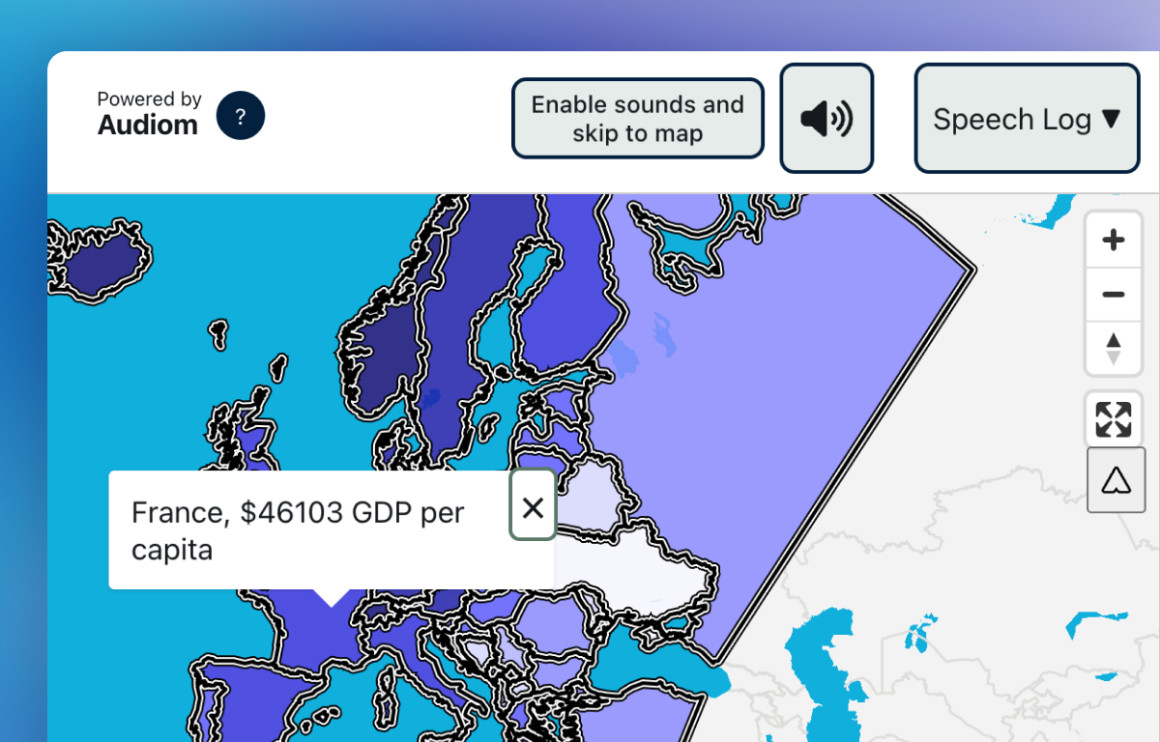
As industry-leading experts in accessible data visualizations, Highcharts will advise on the more technical aspects of proper metadata formats for accessible charts. Highcharts will also work with the Inclusio team to create proofs of concept for dataviz content that can be distributed via the Inclusio platform.
Let’s dive into the what, why and how of this innovative content platform.
The need for accessible content
Did you know that only 11% of people who are blind or visually impaired have earned a college degree?
This statistic helps explain the staggering 60-70% under/unemployment rate among individuals with blindness or visual impairments (BVI), and although there may be multiple factors at play, one thing is certain.
Whether it’s important facts and statistics concerning public health and safety or advanced academic STEM content, if information is not accessible, people with BVI (and persons with disabilities in general) will not be able to consume it, leaving them at a completely avoidable and unfair disadvantage.
But…screen readers
Yes, it’s true that people with BVI can use a screen reader or a tactile medium like braille to “see” content.
But before they can use assistive technology to consume content, someone has to make the content “readable” or “touchable.” And frequently, content creators make their content accessible after the fact.
The resulting “accessible” version is often less robust than the original. This discrepancy in quality creates an information gap between sighted people and people with BVI.
For example, the Inclusio team interviewed a college student who had to change his major because his chosen course of study lacked accessible content.
This challenge is at the forefront of why the Inclusio team has made it their mission to revolutionize the way we create and consume visual content.
Reimagining Access
To help close the information gap between original content and its accessible variants, Inclusio’s platform will enable users to create content specifically designed for whatever method (screen reader, tactile embosser, 20/20 vision) they want to use to consume it.
By merging content creation and accessibility into one step, the Inclusio platform will empower everyone to author information-rich, accessible content tailored to their preferred means of consumption.
Faster Creation with an AI Backbone
In Phase II of the project, the Inclusio team plans to develop the infrastructure to host the content most used by the BVI community.
Initially, humans will create the content, but the eventual goal of the Inclusio team is to incorporate and train AI to complement content creation and optimization, vastly reducing the amount of time and overhead it takes to produce accessible content at scale.
The future of accessible content
Inclusio is more than a cutting-edge tool for creating and distributing accessible visual information. It is a game changer.
By enabling anyone to find and create accessible content in the medium of their choosing, Inclusio ensures everyone has access to the same information from the start, closing the gap between sighted people and people with BVI. As staunch accessibility advocates and leaders in the field, we’re proud to help shape this exciting future.
Disclaimer: NSF Grant Nos. ITE 2235243, 2345159. Any opinions, findings, and conclusions or recommendations expressed in this material are those of the author(s) and do not necessarily reflect the views of the National Science Foundation.
Related posts
- Data visualization library by Highcharts
- Dynamic charts in JavaScript with Highcharts
- Graphing in JavaScript with Highcharts
- JavaScript data visualization with Highcharts
- JavaScript graph visualization library by Highcharts
- JavaScript library by Highcharts






Leave a Reply